Aussies spent over $63 billion shopping online last year, yet most people running a store still couldn’t tell you exactly how the money moves from a customer’s click to their own bank account. Every e commerce business is really just a handful of moving parts working together – a website, a payment system, a way to get stuff delivered, and a plan to get people to notice you in the first place. Once you see how those pieces fit, running your own store gets a lot less confusing.
Table of Contents
The Building Blocks Of An E-Commerce Business
Most people think an online store is just a website with a “buy now” button. That’s a small part of it. Behind every order that lands in someone’s letterbox, there’s a chain of systems working together, and if one link breaks, the whole thing stalls. Understanding these pieces matters even if you’re not the one building them, because it helps you spot where things are going wrong.
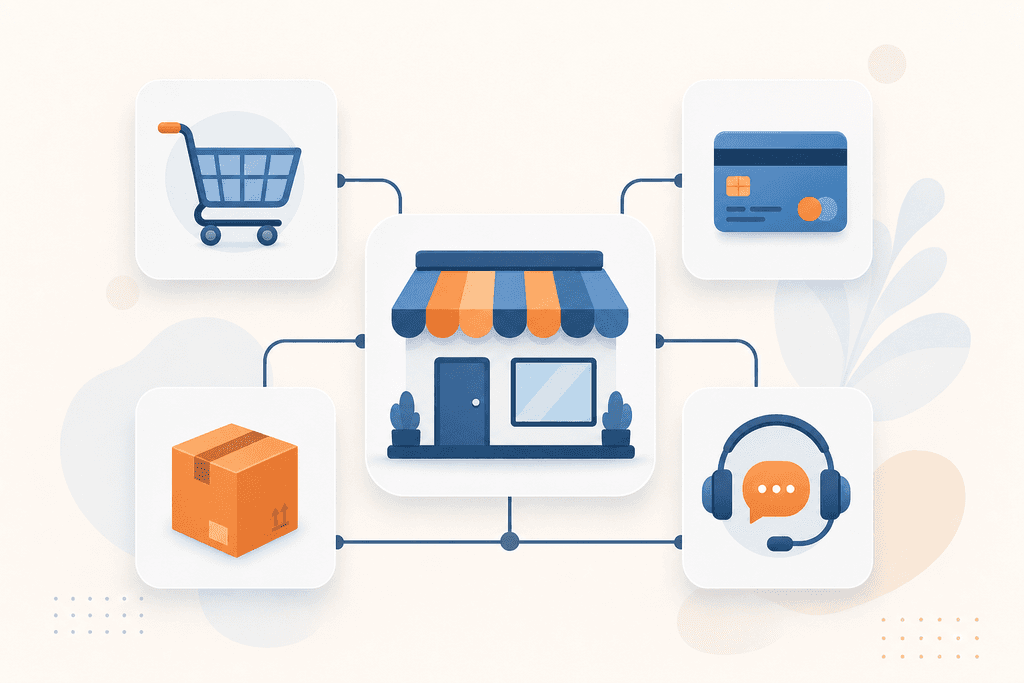
Here’s what’s actually running behind the scenes when someone buys from your store:
- Online storefront and product catalogue — this is the shopfront itself, plus all the product listings, descriptions, and images customers browse through
- Payment gateways and checkout systems — the bit that actually takes the money and keeps card details secure
- Inventory, fulfilment, and shipping logistics — tracking what stock you have and getting it out the door
- Customer service and returns handling — dealing with questions, complaints, and the inevitable “this isn’t what I ordered” emails
A lot of founders get the storefront looking great and then forget the boring stuff. But fulfilment delays and clunky checkouts are two of the biggest reasons people abandon a cart and never come back. It doesn’t matter how nice your product photos are if the box takes three weeks to arrive.
How An E-Commerce Business Actually Makes Money
There isn’t just one way to run an online store. Different businesses make money in completely different ways, and picking the wrong model for your situation is a common reason things don’t work out. Some people hold no stock at all. Others manufacture their own products and sell direct. Knowing which model you’re actually running (and why) changes almost every decision after that, from pricing to marketing.
The main models look like this:
- Dropshipping — selling products without holding any stock yourself, a supplier ships direct to the customer
- Wholesale and private label — buying in bulk or manufacturing your own goods, then selling at a margin
- Subscription models — recurring revenue from repeat boxes or ongoing services
- Digital products — selling downloadable files, courses, or licensed goods with no physical shipping at all
- Marketplace selling — using platforms like Amazon or Etsy instead of (or alongside) your own site
- B2B vs B2C — selling to other businesses versus selling to individual shoppers, which changes everything from order size to sales cycle length
| Model | Upfront Cost | Main Income Source |
|---|---|---|
| Dropshipping | Low | Margin per sale |
| Wholesale/Private Label | High | Bulk margin |
| Subscription | Medium | Recurring fees |
| Digital Products | Low | Repeat downloads |
| Marketplace | Low to Medium | Per-sale margin |
If you want to see how this plays out in the real world, this roundup of e-commerce case studies shows how different businesses picked a model and scaled with it, and it’s worth a read if you’re still figuring out which lane suits you.
How E-Commerce Businesses Attract Customers
Having a great product and a smooth checkout means nothing if no one finds your store. This is where a lot of founders either overspend on ads that stop working the second they turn off the budget, or ignore organic growth because it feels slow. The truth is, most stores that last use a mix of both, but they weight it differently depending on how much cash they’ve got to burn versus how much time they’ve got to build something that sticks around.
Broadly, customers come from two directions:
- Organic channels — SEO, content, and digital PR that build visibility over months and keep working long after you’ve stopped actively pushing them
- Paid channels — social ads, search ads, and marketplace ads that bring traffic fast but disappear the moment spending stops
Neither one is “better” outright, it depends on your stage and goals. Quick comparison:
- Paid — fast results, but costs scale with growth and stop the second you pause spending
- Organic — slower to build, but compounds over time and doesn’t vanish overnight
This is really the space we live in at ScaleCurrent. We focus on organic authority — the kind of SEO, content, and digital PR work that builds a store’s visibility in a way that doesn’t disappear the second an ad budget runs dry. It’s not the flashiest approach, but it tends to be the one still paying off a year later. For founders wanting a deeper look at what separates stores that scale from ones that stall, this collection of e-commerce success examples is a solid place to poke around.
What This Means For Your Online Store
Here’s something most founders don’t realise until they’ve burned through a chunk of their marketing budget: nearly 40% of e-commerce traffic in Australia comes from organic search, not paid ads or social media. That’s a huge chunk of potential customers finding you through Google, not through money you’re spending every single day. So if your online store is only set up to chase clicks through ads, you’re leaving a massive channel untouched. Picking the right revenue model matters, sure, but none of it works if nobody can find your store in the first place.
This is where a lot of e commerce business owners get stuck. They pick a model, maybe subscription or wholesale or direct-to-consumer, without thinking about whether it actually fits their resources, team size, or how much cash they’ve got to play with. A subscription model sounds great until you realise it needs consistent content and retention work to keep it alive.
- Do you have the stock and cash flow for a wholesale model
- Can your team handle the customer service load of a direct model
- Is your product suited to repeat purchases or one-off sales
- Do you have time to build the organic presence needed to support any of this
The truth is, the business model you choose only works if people can actually find you. That’s why visibility and structure need to be part of the same conversation from day one, not something you bolt on later once sales stall.
This is exactly why ScaleCurrent starts every engagement with a proper diagnosis before recommending anything. We look at your current setup, your traffic sources, your content, and your backlink profile before suggesting a single change. It’s not glamorous work, but it means the growth path we map out actually fits your store instead of some generic template.
- Audit your current organic visibility and technical health
- Map your content against what your customers are actually searching for
- Build a backlink strategy through ethical digital PR
- Prioritise fixes based on what will move revenue, not vanity metrics
None of this is complicated stuff, but it does take a structured approach. Organic Authority SEO only works when it’s built on a clear understanding of how your specific store makes money.
Wrap-Up
So here’s the thing about running an e commerce business. It’s really just a few moving parts working together. You’ve got your products, your website, a way to get paid, and a way to ship stuff out. Sounds simple when you put it like that, but most people get stuck trying to make all these pieces work at once.
We covered how businesses actually make money too. Some go the dropshipping route, others build subscription boxes, and plenty just sell straight up inventory. There’s no one right way to do it. What matters more is picking a model that fits what you’re actually selling.
But here’s the part a lot of store owners miss. You can have the best product in Australia, but if nobody can find your store, none of that matters. Getting found online isn’t a nice-to-have anymore. It’s basically the whole game.
This is where things get interesting, because ranking well isn’t about tricks or shortcuts. It’s about building real authority over time, which is exactly what our Organic Authority SEO service focuses on for product-based businesses.
Once you get the basics down, growing your store stops feeling like guesswork. You start making decisions with a bit more confidence instead of just hoping something sticks.
Now, you’re probably wondering about a few more specific things, like how long this all takes or what to focus on first. That’s exactly what we’ll get into next.
Common Questions About E-Commerce Businesses
Got more questions rattling around your head? That’s normal. Running an e commerce business brings up a lot of “wait, how does that actually work” moments, even for people who’ve been at it a while. Here’s the quick rundown on what people ask most.
What is an e-commerce business in simple terms
It’s just a business that sells stuff online instead of in a physical shop. Could be products, could be services, but the money changes hands over the internet.
How does an e-commerce business make money
Mostly the same way any shop does, by selling something for more than it costs to make or buy. The difference is the costs look different online, things like:
- Website hosting and platform fees instead of shop rent
- Shipping and packaging instead of in-store staff
- Ads and SEO instead of foot traffic
What is the easiest e-commerce model to start
Print on demand or dropshipping tend to be the easiest because you don’t need to hold stock upfront. That said, easy to start doesn’t always mean easy to grow, the margins are usually thinner.
Is dropshipping still profitable in Australia
It can be, but shipping times from overseas suppliers and rising ad costs have made it harder than it was a few years back. The ones still making it work usually focus on a niche and build a real brand around it, not just cheap products with a markup.
Do I need a website to run an e-commerce business
Not technically. You can sell through marketplaces like Amazon or social platforms without ever building your own site. But if you want to own your customer data and not rely on someone else’s rules, a website is worth having eventually.
What is the difference between B2B and B2C e-commerce
B2C is selling straight to everyday shoppers, think a candle brand selling on its own site. B2B is selling to other businesses, usually in bulk, with longer sales cycles and different pricing rules. The buying decisions in B2B also involve more people, which changes how you market to them.
If any of this stirred up a “but how do I actually get found online” question, that’s a different beast entirely, and it’s kind of our whole thing at ScaleCurrent.
Want to know how visible your business is in Google and in AI answers? Request an authority audit and we will show you what is holding it back.