The short answer to how to promote an e commerce website is this: you run paid ads, SEO, email and trust signals at the same time, not one after the other. Most Australian shoppers now check Google or ask an AI tool before they buy anything, even a $40 phone case. If your store only shows up in a Facebook feed, you are missing the part of the buying decision that happens before someone even opens Instagram.
Promotion is not one channel carrying the whole store. A paid ad gets someone to click once. Search visibility gets them back when they are ready to buy. Email turns a browser into a repeat customer. Reviews and clear policies on the product page tell a stranger your store is not a scam. Skip any one of these and the others have to work harder, usually at a higher cost per sale.
Table of Contents
Where Shoppers Actually Find Online Stores
Shoppers don’t pick one channel and stick to it. They hop between search, social feeds, AI chat answers and their inbox depending on how close they are to buying.
| Channel | Best for | Typical buying stage |
|---|---|---|
| Search engines | High intent, ready to buy | Late stage |
| AI chat tools | Product comparisons, research | Early to mid stage |
| Social ads | Discovery, impulse buys | Early stage |
| Repeat purchase, cart recovery | Post-purchase and returning |
A shopper might see a product on a social ad, ask an AI tool to compare it against two others, then search the brand name on Google before paying. If your store is strong on ads but invisible in that middle research step, you lose the sale to whoever shows up there instead.
Knowing which channel your buyers actually use at each stage stops you pouring budget into the wrong one. A business selling $30 phone cases needs different coverage to one selling $3,000 furniture, because the research stage stretches out as the price goes up.
Get Found Before Shoppers Even Search Your Brand
Search engines and AI tools build their answers from the same raw material: your product pages, your reviews and how your site is structured underneath. If a product title is vague, a description is thin, or there’s no schema markup telling Google what the product actually is, both a search engine and an AI chat tool struggle to surface it correctly.
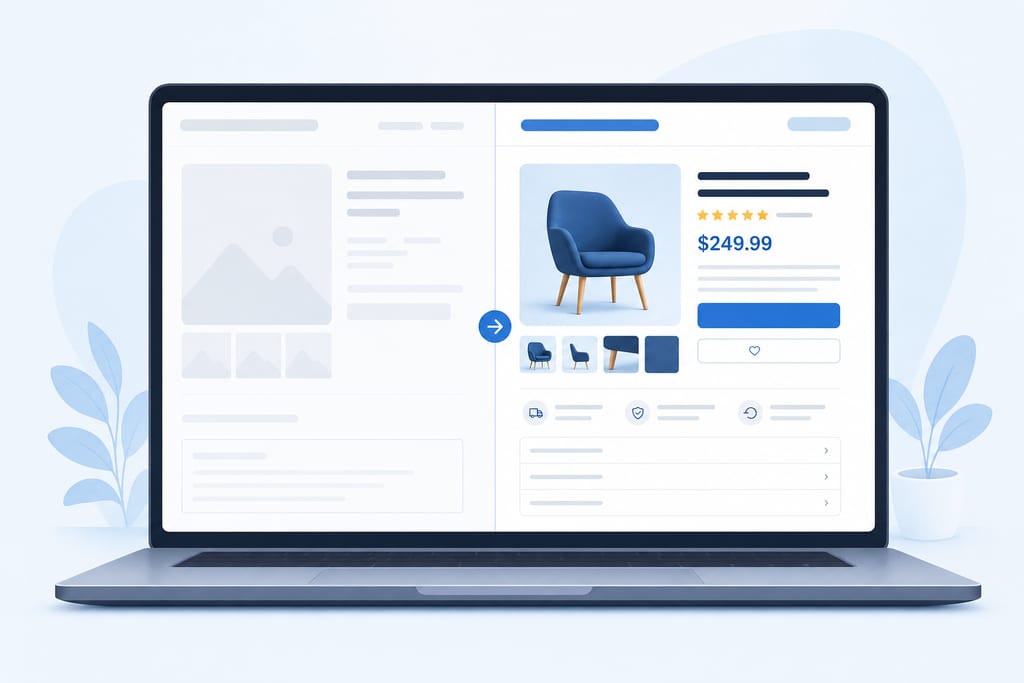
The fix starts on the page itself, not in some separate marketing campaign. Product titles need to match what a buyer actually types or asks, not internal SKU names or vague brand language.
- Product title matches real buyer language, not internal codes
- Description answers the three questions a buyer has before adding to cart
- Schema markup is present on products, reviews and pricing
- At least five genuine reviews sit on the page, not just a star rating
- Category pages link to related products, not dead ends
A free AI check shows exactly how your store currently shows up when someone asks an AI tool to compare products in your category. This is a fast way to see the gap before spending money fixing the wrong page.
Turn Paid Ads Into Repeatable Sales Channels
Retargeting should come before cold prospecting, not after it. People who already viewed a product or added it to cart convert at a far lower cost than strangers seeing your brand for the first time, so scaling cold ads before retargeting is in place just burns budget on traffic that was never close to buying.
Google Shopping ads pull directly from your product feed, so if titles, images or prices are wrong in the feed, the ad shows wrong information and gets rejected or wastes spend. Clean feed data matters more than a bigger ad budget once the basics are running.
- Set retargeting live first, covering cart abandoners and recent viewers
- Check your Shopping feed for missing GTINs, wrong prices or broken images
- Track cost per sale weekly, not just click-through rate
- Pause any ad set with cost per sale above your product margin
- Scale cold prospecting only once retargeting is profitable on its own
Clicks and impressions look good on a dashboard but don’t pay the bills. Cost per sale is the number that tells you whether a channel is actually working.
Keep Customers Coming Back Without Extra Ad Spend
Abandoned cart emails recover sales from people who were already seconds from paying, which makes them the cheapest sale you can make. A simple three-email sequence sent over 48 hours after someone leaves a full cart usually recovers a meaningful slice of that lost revenue without any extra ad spend.
Post-purchase flows do the next job: they turn a one-off buyer into someone who comes back without you paying for another click. A loyalty perk, like early access to new stock, outperforms a generic 10% off blast because it rewards buyers instead of training them to wait for a discount.
- Abandoned cart sequence, three emails over 48 hours
- Order confirmation and shipping update flow
- Post-delivery check-in asking for a review
- Replenishment reminder timed to typical product use-up
- Loyalty or early-access perk for repeat buyers
Each of these runs automatically once it’s set up, so the cost is in the setup, not in ongoing spend.
Build the Trust Signals That Close the Sale
Reviews and ratings do the job a salesperson would do in a physical shop: they tell a stranger that other people bought this and it was fine. A product page with no reviews makes a buyer pause, even if everything else about the page is solid.
Shipping and returns information needs to sit near the buy button, not buried in a footer link, because unclear delivery timing is one of the most common reasons a cart gets abandoned at the last step. A site that takes more than three seconds to load loses sales regardless of how good the traffic source was, whether that traffic came from a Google Shopping ad or an AI tool recommendation.
- Reviews visible on the product page itself, not just a separate tab
- Shipping cost and delivery window shown before checkout
- Returns policy stated in plain language, not legal copy
- Page load time under three seconds on mobile
- Guarantee or warranty stated where the buyer can see it
None of these cost much to fix, but each one removes a reason to leave without buying.
Which Fix Earns Its Spot First
If your product pages and site structure are still messy, fix those first. Every dollar spent on ads or email sends traffic to a page that may not convert, so the order of operations matters more than the size of the budget.
Once the page itself is solid, retargeting and email usually pay back faster than cold ads, because you are spending on people who already know your store. Cold prospecting only makes sense once that cheaper layer is profitable on its own.
| Option | Cost to get right | Who it suits |
|---|---|---|
| Product page and structure fixes | Time, little to no ad spend | Stores with real traffic but weak conversion |
| Retargeting and email flows | Low spend, some setup time | Stores with existing visitors or past buyers |
| Cold prospecting ads | Highest ongoing spend | Stores where retargeting is already profitable |
| AI search visibility checks | Low cost, compounding over time | Any store wanting a free channel early |
Checking how your store shows up in AI chat answers costs nothing and the benefit builds over time rather than draining away like ad spend does. A AI SEO check is worth doing early, before you commit real budget to paid channels, simply because it tells you whether you are invisible in a research step you can’t see on any ad dashboard.
Pick the One Area You’ll Fix This Week
Look at the four areas again: product visibility, paid ads, retention emails, trust signals. Pick whichever one is weakest in your store right now and work on that before adding a new channel or raising ad spend. Adding more traffic to a weak product page or a store with no abandoned cart emails just wastes money faster. A free AI check from ScaleCurrent is a quick way to see where your store is actually falling short before you decide where to spend time or budget. A structural fix on an existing page usually earns more than another ad campaign built on top of problems nobody’s looked at yet.
Want more customers from Google and AI search? Tell us about your business.
Promoting an Ecommerce Store
Is it better to fix the website first or start running ads straight away?
Fix the website first if your product pages are weak, since ads just push traffic to a page that won’t convert. If your pages already load fast, show reviews and have clear shipping terms, you can run ads alongside small fixes rather than waiting. The risk isn’t the order itself, it’s spending on traffic before you know the page can hold it.
How much budget does a small Australian store actually need to start seeing sales?
There’s no fixed figure that works for every store, because margin per sale decides what you can spend to get one. A store selling $30 items needs a tighter cost per sale than one selling $300 items, so set your budget around your margin, not around a round number you’ve seen elsewhere. Start small, track cost per sale weekly, and raise spend only once a channel proves itself.
Will chasing AI search visibility actually bring paying customers, or just traffic?
It brings customers who are already comparing products, which is a later, more serious stage of buying than someone just browsing a feed. A shopper asking an AI tool to compare two products is closer to paying than one scrolling for entertainment. ScaleCurrent’s free AI check shows whether your store even appears in that comparison step before you spend time chasing it.
What’s a realistic timeframe before promotion efforts show up in sales numbers?
Retargeting and abandoned cart emails can show results within a couple of weeks, since they work on people who already know your store. Product page fixes and AI search visibility take longer, often a few months, because they rely on search engines and AI tools recrawling and trusting the changes. Cold prospecting ads take the longest to judge fairly, since you need enough spend to see a true cost per sale.