Answer engine optimisation means writing and structuring your content so tools like ChatGPT, Gemini and Google AI Overviews can lift it straight into their answer, word for word, with your brand attached. A growing slice of shoppers now ask an AI chat window which running shoes suit flat feet or which Melbourne supplier ships bamboo cutlery, instead of typing that into Google and clicking through ten blue links. For an online retailer, that is a real shift in where buying decisions start.
Old SEO was about earning a ranking spot on a results page, then hoping someone clicked your listing over a rival’s. AEO skips that step. The AI reads a pile of pages, picks the clearest and most specific one, and quotes it as the answer, sometimes without sending any click at all. Your product page or FAQ either gets chosen as that source or it gets left out of the conversation entirely.
Table of Contents
Why Shoppers Are Asking AI Instead of Googling
A shopper used to type three or four words into Google, scan a results page, then open a few tabs to compare. Now the same shopper might type a full sentence into an AI chat tool and expect one clear answer back, no tabs required.
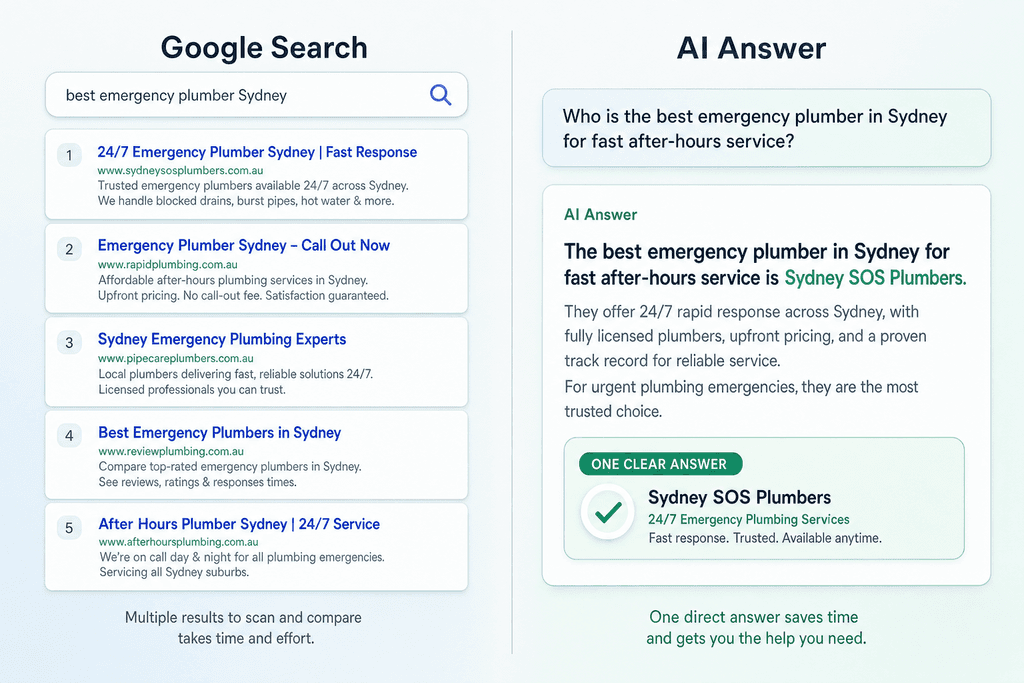
This changes what “ranking well” even means. A product page built for keyword matching does not help if the AI tool is reading full sentences and pulling out the clearest answer, not the page with the most repeated phrase.
| Traditional search | AI search |
|---|---|
| Short keyword phrases | Full conversational questions |
| Ten ranked links to click | One summarised answer |
| Shopper compares pages themselves | AI compares sources before answering |
| Click needed to get detail | Answer often given with no click |
The difference matters most at the research stage, before a shopper has picked a brand. According to this guide on SEO, GEO and AEO, this question-first behaviour is becoming the default way people search, not a side habit confined to one age group or device.
What Answer Engine Optimisation Actually Means
AEO is the practice of writing and structuring content so AI systems can pull it straight into an answer, rather than just indexing it for a results page. It covers things like answering a question in the first sentence, adding structured data markup, and writing short factual statements an AI can quote whole, with no editing needed. The goal is simple: get quoted inside an AI answer, not just ranked and clicked.
The core shift is this: SEO is about being the destination, AEO is about being the source. A retailer selling bamboo cutlery used to care about ranking page one for a search phrase. Now the same retailer needs a page that states, in one clean sentence, what the product is made from, what it costs, and how fast it ships, because that sentence is what gets lifted into the answer.
- Write the direct answer in the first sentence of a page
- Use schema markup so AI tools can parse price, stock and specs
- Keep factual claims short enough to quote whole
- Format FAQs as literal question and answer pairs
How SEO and AEO Actually Differ
SEO aims for a ranking position on a results page. AEO aims for a mention inside an AI-generated answer, which can appear with no ranking position at all. SEO still leans heavily on backlinks and domain authority, while AEO responds more to clarity, structure and facts an AI tool can trust without checking five other sources.
| Factor | SEO | AEO |
|---|---|---|
| Goal | Ranking position | Inclusion in answer |
| Main signal | Backlinks, domain authority | Clarity, structure, facts |
| Success metric | Clicks, rankings | Citations, mentions |
| Typical output | List of links | Single quoted answer |
A page can rank on page one and still never get quoted by an AI tool, and a page with no ranking at all can get cited directly. That split is worth checking page by page, not assuming one score covers both.
- Check if your top product page appears in Google AI Overviews
- Check if your FAQ answers sit under 40 words each
- Check if pricing and shipping details sit in plain text, not images
- Ask an AI tool about your category and see whose name it gives
Where Local Service Businesses Fit Into This
Local service businesses here means trades, clinics and professional services rather than online retailers, but the shift is the same one. Customers now ask an AI tool things like “best plumber near me open now” or “physio in Parramatta that bulk bills,” expecting one answer, not a map pin and ten listings.
To get picked, the business needs plain, factual content about services, suburbs covered and pricing, written where an AI tool can lift it whole. This is not the same job as managing a Google Business Profile. A profile can be fully set up and still not get quoted, because the quote comes from the website content itself, not the listing, which is why this work gets layered onto local SEO as an add-on through AI SEO.
- List suburbs served in plain text, not just on a map widget
- State call-out fees, bulk billing or starting prices directly on the page
- Write one sentence answering “do you offer this service in this suburb”
- Keep opening hours and emergency availability in text, not an image
Signs Your Business Needs Both Strategies
A few warning signs tell you it’s time to look at AEO alongside your existing SEO work. If competitors show up inside AI Overviews or a ChatGPT answer for your category and you don’t, that’s the clearest signal going.
Other signs sit closer to home. If your site content runs in long paragraphs with no direct answer near the top, an AI tool has nothing clean to quote. Most businesses have never actually checked whether an AI tool can find or cite their pages at all. A free AI check or a Search Audit is the simplest place to start, not a full site rebuild, and it shows which pages are answer-ready and which need rewriting.
- Search your own business category in ChatGPT and see who gets named
- Check if your service pages open with a direct answer
- Run a free AI check to see which pages AI tools can currently cite
- Compare your FAQ structure against competitors who already get quoted
Act Now Or Wait It Out
Nothing about AEO replaces the groundwork SEO already demands. Both still need a site Google and AI crawlers can read cleanly, with proper structure and no broken markup. Skipping that foundation breaks either strategy, not just one.
The real choice is timing, not either-or. Search behaviour is already shifting enough that a growing share of searches now end without a single click to any website, because the AI answer satisfied the question on its own. Ignore that shift and a retailer’s product pages simply stop showing up in that slice of searches, no matter how well they rank on page one.
Early movers get an advantage most traditional SEO work can’t offer anymore: less competition. Traditional rankings are crowded after years of businesses fighting for the same ten spots, but AI answers are still being built from a much smaller pool of pages written the right way.
| Business type | Risk of waiting | Value of acting now |
|---|---|---|
| New e-commerce store, few product reviews | Low, little AI visibility to lose yet | Moderate, early structure pays off later |
| Established retailer with ranking product pages | High, rivals can be quoted instead | High, protects existing traffic |
| Niche category with specific buyer questions | High, AI answers favour clear specifics | High, small pool of competing sources |
| Broad marketplace seller, generic listings | Moderate, harder for AI to quote cleanly | Low until listings are rewritten |
A store with ranking pages and specific buyer questions to answer has the most to lose by waiting. A brand-new storefront with thin content has less at stake right now, but that gap closes fast once competitors start writing answer-ready pages first.
Check Whether AI Tools Already Know Your Store
Don’t guess at this part. Open ChatGPT or Gemini, ask about your product category, and see whose name comes back. If it’s not yours, that’s worth knowing before you spend another cent on content or ads. ScaleCurrent runs a free AI check or Search Audit that shows exactly where your current SEO stands against what AI tools need to quote you, page by page, so you know which ones need rewriting and which are already close. Send an email to hello@scalecurrent.com.au and get that answer before you decide what to fix next.
Want more customers from Google and AI search? Tell us about your business.
Answer Engine Optimisation Questions
Will AI tools eventually replace Google search entirely?
Not any time soon. Google still handles billions of searches a day and AI Overviews sit inside Google itself, not apart from it. What’s changing is the mix, more shoppers get an answer without clicking, so your pages need to work for both a ranked result and a quoted answer at the same time.
Does answer engine optimisation cost more than regular SEO?
It doesn’t have to be a separate budget line. AEO work is mostly rewriting and structuring content you already have, like FAQs and product details, so it’s closer to a focused editing job than a new campaign. ScaleCurrent runs it as an add-on to local SEO rather than a standalone service with its own pricing.
Can a small online store realistically compete for AI answer visibility?
Yes, and sometimes more easily than for Google rankings. AI tools pull from whichever page states the answer most plainly, not whichever site has the biggest backlink profile, so a small store with clear, specific product pages can get quoted ahead of a bigger competitor whose pages are vague.
What happens if my pages aren’t ready and AI tools quote a competitor instead?
You lose that shopper before they ever see your site, because the AI answer already satisfied their question with someone else’s name attached. There’s no penalty beyond that, but it’s a quiet loss that doesn’t show up in your usual traffic reports, which is why it’s worth checking directly rather than assuming your rankings cover it.