A Shopify SEO agency is worth hiring only if it can show you rankings and traffic that moved because of its work, not because of a seasonal sales spike. Most Shopify stores run the same handful of themes, pull from the same supplier feeds, and write near-identical product titles, so the storefront itself rarely sets you apart. What separates the stores on page one from the ones stuck on page four is the technical work underneath: site structure, page speed, duplicate collection pages, how the catalogue is crawled. That is the part a good agency fixes, and the part a weak one talks around.
Picking between agencies should feel like checking references, not listening to a pitch. Ask what a firm actually did for a store your size, what changed in Search Console, and how long it took. Any agency can promise a page one ranking. Few can show you a traffic graph with a date on it that matches when they started. That difference is what the rest of this comes down to, along with what the work should reasonably cost and what proof you should ask for before signing anything.
Table of Contents
Why Shopify Stores Need Different SEO Treatment
Shopify generates URLs in ways that catch agencies built for WordPress off guard. A single product can spin up several variant and collection URLs, and the platform’s locked-down CMS means you cannot edit robots rules or server responses the way you can on an open build. Add a dozen apps for reviews, upsells, and filtering, and each one can drop extra scripts that slow the store down.
Plenty of store owners spend months writing blog posts and product descriptions before anyone checks whether Google can even crawl the catalogue properly. Fixing crawl errors and page speed first usually moves the needle faster than new content, because content sitting on a slow, duplicated site structure has less chance of ranking.
| Shopify SEO Problem | Typical Revenue Impact |
|---|---|
| Duplicate variant URLs diluting rankings | Lost traffic to near-identical pages |
| App scripts slowing load time | Higher cart abandonment on mobile |
| Thin collection pages with no unique copy | Pages stuck below page one |
| Broken redirects after product changes | Dead links losing referral and search traffic |
A deeper breakdown of how these fixes played out on real stores sits in this Shopify SEO case study roundup, worth a look before you assume a generic agency has this covered.
Top Shopify SEO Agencies Compared
Agency types split roughly into four camps, and each one suits a different stage of store growth. Full-service e-commerce agencies run paid ads, email, and SEO together, which suits stores with the budget to coordinate all three. Boutique Shopify specialists focus only on the platform’s quirks, freelancer collectives offer lower rates but less accountability, and diagnostic-first shops start with an audit before quoting ongoing work.
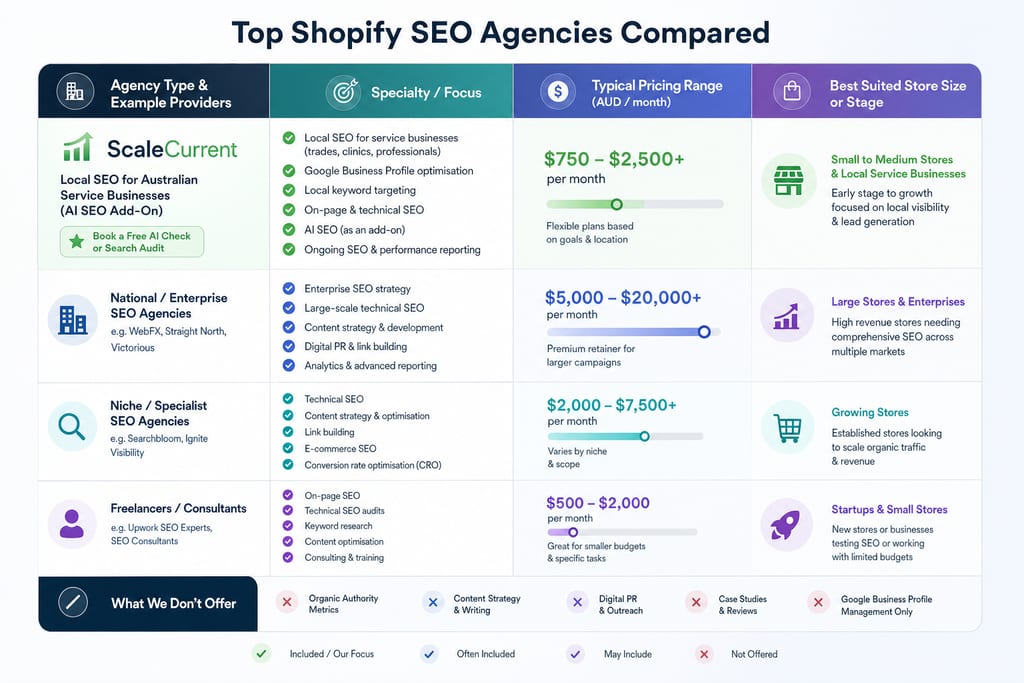
| Agency Type | Specialty | Typical Monthly Cost | Best Fit |
|---|---|---|---|
| Full-service e-commerce agency | SEO plus paid ads and email | $4,000–$8,000+ | Established multi-million dollar stores |
| Boutique Shopify specialist | Technical platform fixes | $2,500–$5,000 | Growth-stage stores |
| Freelancer collective | Ad hoc audits and fixes | $1,500–$3,000 | Pre-revenue or early stores |
| Diagnostic-first local SEO shop | Audit before retainer | Audit fee, then $1,500–$4,000 | Any stage wanting proof first |
The $1,500 to $8,000+ range covers almost every legitimate quote you’ll see, so anything well outside it needs a harder look. A pre-revenue store rarely needs a $6,000 retainer, and an established store doing seven figures shouldn’t be paying freelancer rates for structural fixes.
What to Check Before You Sign Anything
Run a short diagnostic on any agency before you hand over a card number. The point is to confirm they understand your store, not just their own pitch deck.
- Ask for a sample technical audit on a store similar to yours, not a generic template.
- Confirm whether pricing is retainer, project-based, or tied to performance.
- Ask directly how they handle collection page cannibalisation and duplicate variant URLs.
- Get the scope in writing so you know what triggers an upsell later.
The scope document matters more than the sales call, because that’s the piece you’ll point back to if work stalls. An agency that can’t produce a sample audit on request usually doesn’t have one worth showing.
Proof of Results You Should Demand First
Rankings alone prove almost nothing, because a term can sit at position three with zero traffic behind it. Ask for organic traffic and revenue screenshots from Search Console or Google Analytics, pulled from the same account the agency actually worked on.
- Before-and-after organic traffic graphs with dates that line up with the work starting.
- Revenue or conversion numbers tied to that traffic, not isolated ranking charts.
- A sample audit report you can read without a sales call attached.
- A plain answer on how long their last three clients took to see movement.
Genuine Shopify SEO gains usually take three to six months to show up in analytics, so an agency promising results inside a few weeks is either overselling or counting a paid spike as organic. One source worth reading before you sign anything is this guide on choosing a Shopify SEO agency, which covers similar red flags.
How Shopify SEO Pricing Actually Works
Three pricing models cover almost every agreement you’ll be offered. Picking the wrong one for your stage is the most common way stores overpay.
- Retainer: monthly fee for ongoing fixes and monitoring, best once you’ve cleared the big structural issues.
- Project or audit: a one-off fee for a diagnostic, best before committing to ongoing spend.
- Performance-based: rare, usually tied to ranking or traffic targets, and often hides a higher base fee.
| Model | Typical Cost | What’s Included |
|---|---|---|
| Retainer | $1,500–$8,000/month | Ongoing technical fixes, monitoring |
| Project/audit | $800–$3,000 one-off | Single diagnostic report, no ongoing work |
| Performance-based | Base fee plus bonus | Fixes tied to agreed metrics |
A store still deciding how much work it even needs is usually better off starting with an audit, similar to how local SEO work for service businesses often begins with a diagnostic before any retainer gets signed. That sequence, audit first, retainer second, protects you from paying for monitoring on a site that still has unfixed structural problems underneath it.
Which Store Stage Matches Which Spend
A new Shopify store with a few hundred SKUs and no real sales history doesn’t need digital PR or a full content calendar yet. Most of that spend is wasted until the technical base is fixed, because a blog post sitting on duplicate collection URLs won’t rank no matter how well it’s written. The comparison above shows freelancer and audit-first options sitting well under full-service pricing for a reason.
Starting with a technical audit or an AI readiness check lets you see what’s actually broken before you sign a 12-month retainer blind. You get a scoped list of fixes, a sense of how long they’ll take, and a quote that matches the real size of the job, not a guess. An AI readiness check also tells you whether your product pages are showing up in AI-generated answers at all, which a standard technical audit won’t cover.
| Store Stage | Starting Point | Risk of Skipping It |
|---|---|---|
| Pre-revenue, few hundred SKUs | Technical audit only | Overpaying for content work with no base to rank on |
| Growth-stage, some traffic | Audit plus AI readiness check | Missing AI search visibility while chasing rankings |
| Established, seven-figure revenue | Full agency retainer | Structural gaps staying unfixed under a content push |
ScaleCurrent runs a free Search Audit and a free AI SEO check as that diagnostic starting point, without bundling in content strategy or digital PR you’re not ready to pay for. If your store already has years of content sitting on solid technical groundwork and the real gap is content depth or digital PR, a fuller agency model built for that is the better fit, not a diagnostic-first shop.
Get the Audit Before You Get the Invoice
Don’t sign a 12-month retainer on the strength of a sales call. Ask for a sample audit first, read it without anyone pitching you on the phone, and only then decide if the agency’s diagnosis matches what you actually see in Search Console. A free Search Audit or AI check does the same job for free: it tells you what’s broken on your store before you commit a dollar. Email hello@scalecurrent.com.au, book one, and hold it up against whatever an agency hands you. If the two reports don’t agree, that’s the one worth questioning before you spend anything.
Want more customers from Google and AI search? Tell us about your business.
Shopify SEO Questions Store Owners Ask
Can I switch Shopify SEO agencies partway through a retainer?
Yes, but check your contract for a notice period and ownership of the work first. Ask the current agency to hand over login access, a list of changes made, and any redirect maps before you leave. Without that handover, the next agency starts blind and may undo fixes that were working, costing you months you don’t get back.
Do I still need an agency if I already handle my own Shopify marketing?
You can run ads, email, and social yourself and still need help with the technical side. Crawl errors, duplicate variant URLs, and slow page speed sit underneath the marketing you’re doing and usually need someone who can read Search Console properly. Most store owners doing their own marketing bring in an agency just for that technical layer.
What happens if an agency’s fixes break something in my theme?
Get the scope in writing before work starts, including who tests the live site after changes go in. A competent agency works in a staging copy of your theme first, not the live store, and checks checkout and product pages still function before publishing. If that step isn’t in the scope, ask for it added before you sign.
Is it worth paying for Shopify SEO if my store only has a handful of products?
A small catalogue still benefits from fixing crawl issues and duplicate URLs before they multiply as you add stock. A full retainer is usually more than a small store needs, though. ScaleCurrent’s free Search Audit or AI check will tell you what’s actually broken on a small store before you commit to paying anyone for ongoing work.