Table of Contents
What Actually Counts as an AI SEO Agency Today
Here’s something odd, the term “AI SEO agency” didn’t really exist five years ago, but now it gets slapped on almost every marketing website you find. Some of these places just run your keywords through a chatbot and call it a strategy. Others use AI as one tool out of ten, mixed in with real human research and old fashioned digital PR. This gap matters a lot if you’re an Australian e-commerce brand trying to spend your marketing budget wisely. Pick the wrong type and you could end up with a pile of generic content that Google quietly ignores, or worse, penalises.
The confusion mostly comes down to bundling. Agencies package wildly different services under the same label, so two quotes that look similar on paper can mean completely different outcomes for your store. This guide from 10 Top AI SEO Agencies in 2026 shows how broad this space has become, even before you get into local Aussie options.
To make sense of it, here’s a rough breakdown of what you’ll typically find when researching an ai seo agency:
| Type | What They Actually Do | Common Risk |
|---|---|---|
| Content Automation Tool | Mass-produce articles using AI | Thin, repetitive content |
| AI Research Assistant | Use AI for keyword and topic research only | Still needs human strategy |
| Full-Service Strategy Agency | Blend AI tools with human strategy and links | Higher cost, better results |
| Audit-Only Provider | Diagnose issues, no ongoing work | No implementation support |
Some providers, similar in positioning to studiohawk.com.au or supple.com.au, lean heavily on structured audits and reporting. Others, like prosperitymedia.com.au or megaphone.com.au, focus more on broader digital campaigns where SEO is just one piece. And then you’ve got bonfire.com.au style setups that blend content and paid media together. None of this is inherently bad, but it means the label alone tells you very little.
Before comparing agencies properly, it helps to know a few basics:
- AI can speed up research, but it can’t replace commercial judgement
- Mass content generation often hurts trust signals over time
- Backlink quality still matters more than backlink quantity
- Real e-commerce experience changes how recommendations get applied
Understanding these categories sets up the rest of this comparison, because not every “AI SEO agency” is solving the same problem for your business.
Comparing Agency Types Side by Side
Google penalised over 40% of websites using spammy AI content in its March 2024 update, according to Google’s own search blog. That single fact should tell you something. Not all AI SEO is built the same, and picking the wrong agency doesn’t just waste money, it can get your store buried or delisted entirely. So before you sign anything, it helps to know what’s actually out there.
There are basically four types of providers Aussie e-commerce founders run into. Each one has a different mix of cost, risk, and how much attention your store actually gets.
- Boutique agencies – personalised strategy, but often small teams that can’t scale with you
- Enterprise firms like Prosperity Media or Bonfire – big resources, but often templated playbooks that don’t fit niche product businesses
- In-house AI tools – cheap and fast, but risky if content gets published without review
- Specialist providers – diagnosis-first, ethical approach built for online retail specifically
Pricing and reporting depth vary a lot between these options, and so does the actual sales impact. Here’s a rough breakdown of how they stack up.
| Type | Pricing | Safety Practices | Reporting Style | Sales Impact |
|---|---|---|---|---|
| Boutique | Medium | Varies widely | Personal, informal | Moderate |
| Enterprise | High | Standardised | Dashboard-heavy | Slow but steady |
| In-house AI tools | Low | Often unsafe | Minimal | Unpredictable |
| ScaleCurrent | Transparent | Ethical, audit-first | Sales-focused | Measurable |
Places like Studio Hawk or Supple tend to sit somewhere in that boutique-to-enterprise middle ground. They’re not bad agencies, but their process usually isn’t built around the specific pressures of running a product-based store, like managing category pages at scale or fixing thin content across hundreds of SKUs.
Red Flags That Signal Risky AI SEO Tactics
Some agencies sound great on a sales call and then quietly wreck your rankings six months later. The tricky part is that AI SEO problems don’t always show up right away. Content gets published, traffic looks fine for a bit, then Google catches on and your whole category tanks. Knowing what to watch for upfront saves you that headache entirely.
Here’s a simple checklist to run through before you sign with any ai seo agency.
- They promise guaranteed rankings within days or weeks
- Content gets published with no human review or fact-checking
- Backlink quality or digital PR is never mentioned
- Reports focus only on keyword rankings, not actual sales or conversions
- No one on the team can explain how the AI content is checked
If an agency can’t explain their content review process in plain English, that’s usually a sign they don’t have one. A few case studies floating around, like the ones in this collection of SEO case studies, show what real, sustainable growth looks like compared to quick spikes that fade.
Watch out too for agencies that dodge questions about digital PR. Ethical backlink building takes time and real outreach, not shortcuts. If that part of the conversation feels rushed or vague, it’s worth pausing before you commit.
The Criteria That Actually Predict Safe Growth
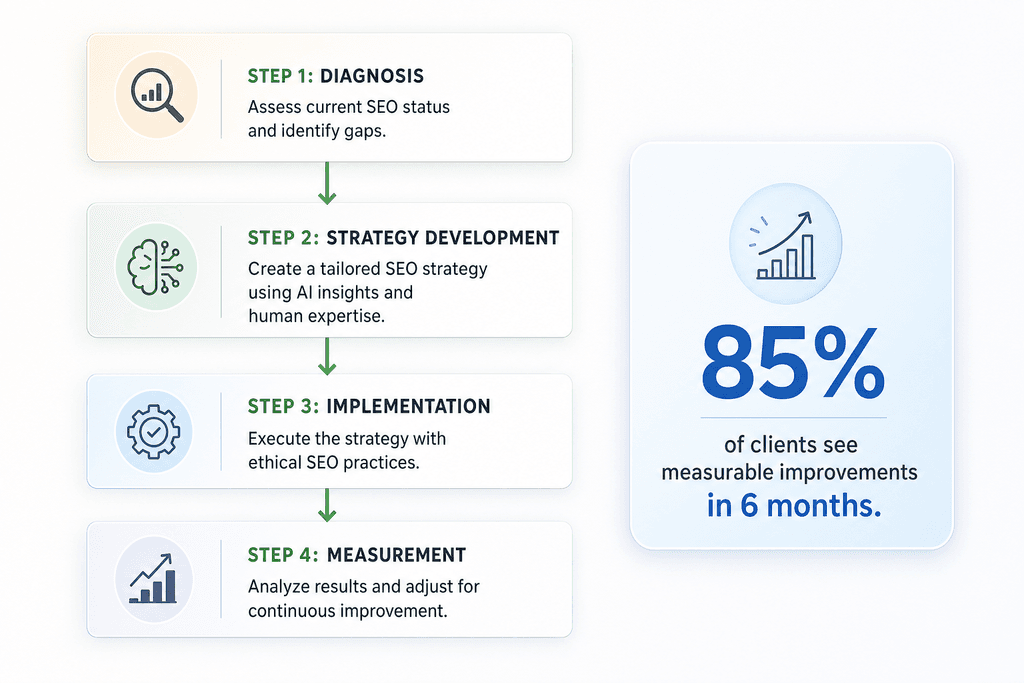
So how do you actually pick a good one? Forget the sales pitch for a second and focus on process. The agencies that deliver safe, lasting growth almost always start the same way, with a proper audit before touching a single page. If a provider jumps straight into content production without diagnosing what’s actually wrong with your site first, that’s usually a shortcut that costs you later.
Run through this list of questions before signing any contract.
- Do they start with a full SEO audit and diagnosis, not just a quick scan
- Is their content strategy tied to sales and conversions, not just traffic volume
- Do they build backlinks through genuine digital PR, not link farms
- Will they report on revenue impact, not just keyword positions
- Has the team actually run or operated an e-commerce business before
That last point matters more than people realise. A lot of agencies, even well-known ones like Megaphone, are staffed by marketers who’ve never had to manage inventory, shipping delays, or a product launch gone wrong. That gap shows up in the recommendations they give.
This is roughly the process our local SEO and AI SEO services follow at ScaleCurrent, diagnose first, build pages around real searches, then report on what actually moved the needle. It’s not flashy, but it’s the difference between an agency that just publishes content and one that treats your store like an actual business. For more detail on how different providers stack up, this roundup of AI SEO agencies is worth a read too.
Our Take on Choosing an AI SEO Partner
Here’s something that should make you pause before hiring the first ai seo agency you find. Nearly 60% of sites using unsafe AI content practices lose their rankings within six months of a major algorithm update. That’s not a small dip either. We’re talking traffic crashes that can wipe out months of revenue overnight. So when businesses ask us why we spend so much time on diagnosis before touching a single piece of content, this stat is basically our answer.
Quick-fix approaches feel great at first. Rankings jump, traffic spikes, everyone’s happy. Then Google rolls out an update and it all falls apart. We’ve seen this pattern too many times to ignore it.
A diagnosis-first approach works differently. Instead of guessing what might work, you actually look at what’s broken first.
- Site structure and technical health checks before any content gets written
- Understanding what’s already ranking and why
- Building content that answers real buyer questions, not just keyword stuffing
- Backlink profiles built through genuine local link outreach, not shortcuts
This is where our operator background actually matters. We’ve run e-commerce stores ourselves, so we know a recommendation that looks good on paper doesn’t always work when you’ve got inventory deadlines, seasonal sales, and a small team. That’s part of why our approach to local SEO focuses on what’s actually doable, not just what’s theoretically ideal.
Some agencies, including bigger names like studiohawk.com.au or prosperitymedia.com.au, take varied approaches to AI content and technical SEO. What we’d encourage you to ask any agency, including us, is how they handle algorithm risk. If the answer is vague, that’s worth noting.
Yes, safe growth takes longer to show results. But avoiding a ranking crash is worth more than a quick spike that disappears in a few months. You can see how this plays out in real SEO case studies that track long-term ranking stability versus short-term wins.
Wrap-up Finding Your Safe AI SEO Match
So here’s the thing about picking an ai seo agency. It’s not really about whether they call themselves an “AI agency” or a “traditional” one. That label doesn’t tell you much at all.
What actually matters is how they work. Do they check your site properly before doing anything. Do they tell you what they’re doing and why. Have the people running your account actually worked inside an online store before, or are they just repeating stuff they read in a course.
Before you sign anything, pull out that comparison table we went through earlier. Run through the red flag checklist too. It only takes a few minutes but it can save you months of wasted spend and a Google penalty you didn’t see coming.
A few things worth checking again:
- Do they explain their process in plain English, not jargon
- Do they show you real audit findings before asking for a contract
- Do they avoid shortcuts like link farms or AI-stuffed pages with no substance
- Have they actually run or worked closely with an online store before
At ScaleCurrent, we start every relationship with a proper diagnosis, not a sales pitch. Our approach leans on ethical SEO and local link outreach, built by people who’ve actually run e-commerce operations, not just studied them from the outside.
Now, you might still be wondering how to spot the warning signs before you’re locked into a contract, or what questions to ask on that first call. That’s exactly what we’ll get into next.
Common Questions About AI SEO Agencies
Picking an ai seo agency can feel confusing when everyone claims to do the same thing. Some Aussie shops charge a flat monthly fee, others bill hourly, and a few just disappear after taking your money. Below are the questions we get asked most by e-commerce founders trying to sort the good from the sketchy. No fluff, just straight answers.
How much does an AI SEO agency cost in Australia
Prices vary a lot, but most agencies sit between $1,500 and $6,000 a month depending on how big your site is and what services you need. Bigger names like studiohawk.com.au or prosperitymedia.com.au often price toward the higher end because of brand recognition, not necessarily better results. Always ask what’s included before signing anything.
Is AI generated content safe for SEO
It can be, but only if a real person edits it and adds actual expertise. Google doesn’t ban AI content outright, it just penalises thin, unhelpful stuff regardless of who wrote it. This is why we treat AI as a drafting tool, not the final writer, when we build out content for clients.
How long until AI SEO shows results in sales
Most stores start seeing movement in rankings around month three, with actual sales impact showing up between month four and six. Anyone promising overnight sales jumps is usually setting you up for disappointment or worse, a penalty later.
What’s the difference between AI SEO and traditional SEO
Traditional SEO relies on manual research and human judgement for keywords, content, and links. AI SEO speeds up the research and pattern spotting, but the strategy and quality checks still need a human behind them. The best setups blend both instead of leaning fully on one.
How do I know if an agency uses risky tactics
Watch for these warning signs:
- Promises of guaranteed rankings within weeks
- Vague answers about where backlinks come from
- Reports full of vanity metrics like traffic with no sales context
- Reluctance to explain their process step by step
Some agencies, including supple.com.au, megaphone.com.au, and bonfire.com.au, focus heavily on link volume, which isn’t automatically bad, but it’s worth asking how those links are earned. At ScaleCurrent, we walk clients through every tactic before it happens, which is part of why our local SEO process starts with a full audit first.
Want more customers from Google and AI search? Tell us about your business.