Most online stores lose more than 97 out of every 100 people who land on their site, and they never even hit checkout. That’s not bad luck, it usually means there’s a leak somewhere in the marketing funnel, the path a stranger takes from first noticing your brand to actually buying something. Once you know where people are dropping off, you can fix the real problem instead of just throwing more money at ads.
Table of Contents
- What Is a Marketing Funnel Anyway
- Top of Funnel Getting Strangers to Notice You
- Middle of Funnel Turning Interest Into Real Consideration
- Bottom of Funnel Getting the Sale Over the Line
- After the Sale Keeping Customers Coming Back
- Where Aussie E-Commerce Brands Lose the Most Customers
- Wrap-Up Turning Funnel Knowledge Into More Sales
- Marketing Funnel Questions Answered
What Is a Marketing Funnel Anyway
Picture a real kitchen funnel. You pour a heap of stuff in the top, but only a little bit trickles out the bottom. That’s basically what happens with your website visitors too. A marketing funnel is just a way to map out how strangers turn into paying customers, step by step. It’s shaped like a funnel because you lose people along the way, and that’s normal, not a failure. Every business, from a small candle shop on Etsy to a massive brand like Bunnings, works off some version of this idea whether they call it that or not.
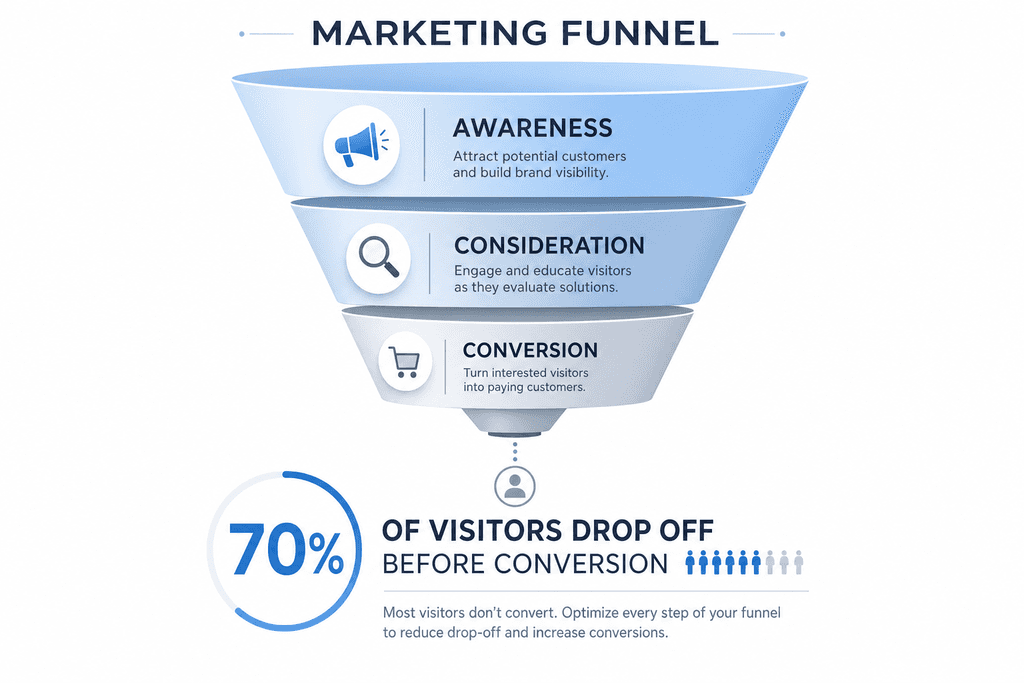
The funnel idea has been around since the late 1800s, believe it or not, when a bloke named E. St. Elmo Lewis came up with a model to explain how ads turn lookers into buyers. That old model is still the backbone of what marketers use today. If you want a deeper dive into where this all came from, this breakdown from Johnson and Wales University covers the stages and tactics in more detail.
The classic version everyone learns first has four stages:
- Awareness, where someone first hears about you
- Interest, where they start paying attention and comparing options
- Decision, where they’re weighing up whether to buy
- Action, where they actually pull out their wallet
But here’s the thing a lot of people miss. Getting the sale isn’t the finish line anymore. Modern funnels add two more stages on the end, Retention and Advocacy, because keeping a customer and turning them into a fan is often cheaper and more valuable than chasing a brand new one.
| Stage | Customer Mindset | Business Goal |
|---|---|---|
| Awareness | “Never heard of them” | Get noticed |
| Interest | “Tell me more” | Educate and engage |
| Decision | “Comparing options” | Build trust |
| Action | “Ready to buy” | Make it easy to purchase |
| Retention | “Happy with my purchase” | Keep them coming back |
| Advocacy | “I’ll tell my mates” | Turn buyers into promoters |
Understanding these stages matters because most businesses only focus on the top and bottom, getting clicks and getting sales, while ignoring everything in between. That gap is usually where organic authority SEO and smart content strategy can make the biggest difference.
Top of Funnel Getting Strangers to Notice You
Most online shoppers don’t wake up looking for your brand. They’re searching for a problem to solve, like “best running shoes for flat feet” or “eco-friendly kids toys.” This is the Awareness stage, and it’s not about selling anything yet. It’s about showing up when someone’s looking, even if they don’t know your business exists. For Australian e-commerce brands, this means being visible in search results, not just running ads and hoping for clicks.
Organic SEO and content strategy are what build this kind of visibility long term. Instead of paying for every click, you’re creating pages and content that keep bringing people back month after month. This is slower than paid ads, but it compounds. A blog post you write today could still be pulling in traffic two years from now.
Backlinks matter here too. Digital PR and backlinks build authority that search engines trust, which helps your site rank higher without constantly paying for placement. According to Moz’s guide on backlinks, sites with strong, relevant backlink profiles tend to outrank competitors with thinner link profiles, even if those competitors have similar content.
One thing to watch out for: avoid vanity metrics like raw traffic numbers without context. Ten thousand visitors a month means nothing if none of them buy. What matters is whether the right people are finding you.
Common awareness stage tactics worth doing properly:
- Blog content that answers real customer questions
- SEO audits to find what’s blocking your rankings
- Digital PR to earn mentions on relevant sites
- On-page SEO fixes for product and category pages
Middle of Funnel Turning Interest Into Real Consideration
Once someone knows you exist, they start comparing. This is the Interest and Consideration stage, where a shopper has three tabs open, one for your site and two for competitors. They’re reading reviews, checking prices, and looking for reasons to trust one brand over another. If your content doesn’t answer their questions clearly, they’ll just click over to whoever does.
Product content, reviews, and comparison pages do the heavy lifting here. A detailed buying guide or an honest comparison page can do more for conversions than another discount code. Shoppers want proof, not just claims.
Retargeting ads and email nurture sequences also help keep your brand top of mind while people are still deciding. Someone who browsed your site last week might need a gentle reminder before they’re ready to buy.
There’s a newer piece to this too. AI SEO helps content appear in AI search summaries and answer engines, which is becoming more common as shoppers use tools like ChatGPT or Google’s AI overviews to research before buying. If your content isn’t structured for that, you’re missing a growing chunk of research traffic.
Content that tends to work well at this stage includes:
- Buying guides comparing features and price points
- Customer review pages with real photos and feedback
- Side by side comparison pages against competitors
- FAQ sections that answer objections before checkout
Bottom of Funnel Getting the Sale Over the Line
By the time someone reaches the Decision stage, they don’t need more information. They need reassurance. This is where a lot of Australian online stores lose sales they’ve already worked hard to earn, usually over small stuff that could’ve been fixed weeks ago.
The usual suspects causing friction are pretty predictable:
- Shipping costs that show up as a surprise at checkout
- Return policies that are vague or hard to find
- Checkout forms with too many steps or fields
- No clear guarantee or trust badges near the buy button
Clear calls to action, guarantees, and social proof like reviews or star ratings near the checkout button all reduce hesitation at the exact moment it matters most.
The average cart abandonment rate sits around 70 percent across e-commerce, according to Baymard Institute’s research. Even a small improvement here, like a 2 to 3 percent lift in conversion rate, can mean thousands of extra dollars a month without spending more on ads. It’s not about massive redesigns, usually it’s fixing the annoying little things that make people bail.
After the Sale Keeping Customers Coming Back
Getting the first sale is only half the job. What happens after is where a lot of Australian e-commerce brands leave money on the table. Repeat customers already trust you, so they cost far less to convert than someone brand new who’s never heard of you.
| Approach | Relative Cost | Typical Effort |
|---|---|---|
| Acquiring new customer | High | High |
| Retaining existing customer | Low | Low to medium |
Email marketing, loyalty programs, and post-purchase content (like care guides or how-to-use emails) all help keep customers engaged after checkout. A simple “how to get the most out of your product” email can do more for retention than another discount blast.
Happy customers become organic advocates through reviews and referrals, which feeds back into the top of the funnel. This is the part of the funnel that quietly fuels the next one.
Retention data is also worth paying attention to for strategy, not just sales. What customers ask about after buying often reveals gaps in your content or SEO that are worth fixing. This is something we look at closely as part of our content strategy work, because the questions people ask after a sale are usually the same ones stopping other visitors from buying in the first place.
Where Aussie E-Commerce Brands Lose the Most Customers
Here’s something that surprises a lot of store owners: getting more traffic doesn’t always mean more sales. We see this constantly with Australian e-commerce brands. They pour money into ads and content to drive people to the site, but the marketing funnel has a leak somewhere in the middle, and all that traffic just drains out without converting. It’s like filling a bucket with holes in it. You keep adding water, but the level never rises. This is one of the most common patterns we spot when we start working with a new client.
Most businesses assume their problem is at the top, so they chase more visitors instead of looking at why the ones they already have aren’t buying. This is where a proper SEO audit becomes useful, because it doesn’t just look at rankings, it maps out where people are dropping off. Sometimes it’s a slow checkout page. Sometimes product descriptions don’t answer the questions people actually have. You won’t know until you check.
Top of Funnel vs Bottom of Funnel Spend
- Pro of top of funnel focus: builds brand awareness and reaches new audiences
- Con of top of funnel focus: wastes budget if the site can’t convert what it already gets
- Pro of bottom of funnel focus: fixes leaks fast, often cheaper than buying more traffic
- Con of bottom of funnel focus: won’t help if you genuinely don’t have enough visitors to begin with
This is why we don’t guess. According to Amazon’s guide on how marketing funnels work, each stage needs different signals to measure success, and mixing them up leads to wasted spend. Structured, ethical SEO plays a role at every stage too, not just the top, because authority and trust influence whether someone clicks, stays, and eventually buys.
What sets our approach apart is that we’ve actually run e-commerce operations ourselves. We know funnel theory looks tidy on a slide, but real stores have messy realities like inventory issues, slow load times, and confusing navigation. That operator background helps us translate the diagnosis into fixes that actually make sense for how your business runs day to day.
Wrap-Up Turning Funnel Knowledge Into More Sales
So here’s the thing about a marketing funnel. It’s not one big pipe, it’s four different stages, and each one needs its own type of content and its own tactic. What works to grab attention won’t be what convinces someone to actually buy. Mixing these up is where a lot of Aussie stores lose people without even realising it.
The smart move is figuring out which stage is leaking before you spend another dollar on ads. Maybe your traffic is fine but nobody’s converting. Maybe people convert once and never come back. Either way, throwing more budget at the top of the funnel won’t fix a problem sitting further down.
A few things worth remembering:
- Awareness needs content that answers real questions, not just brand noise
- Consideration needs proof, like reviews and comparisons, not just product specs
- Conversion needs trust signals and a smooth checkout, not more discounts
- Retention needs a reason to come back, not a one-off sale
This is really where ScaleCurrent’s structured approach comes in. Our Organic Authority SEO and content strategy work isn’t just about pulling in more visitors. It’s built to support every stage of the funnel, so the traffic you already have converts better before you spend more getting new traffic in the door.
Fixing one stage at a time, backed by proper data and not guesswork, is what actually moves the needle long term. Still got questions about how this applies to your own store? That’s what we’ll get into next.
Marketing Funnel Questions Answered
Got more questions about how a marketing funnel actually works for your store? Here’s a quick rundown of what Aussie e-commerce founders usually want to know before they start fixing theirs.
How many stages does a marketing funnel have
Most marketers break it into four stages: awareness, consideration, decision, and retention. Some add a fifth stage for advocacy, where happy customers start referring others. The exact number matters less than making sure each stage actually connects to the next one.
What is the difference between a sales funnel and marketing funnel
A marketing funnel covers the whole journey, from someone first hearing about your brand right through to becoming a repeat buyer. A sales funnel is narrower and usually starts once someone’s already shown buying intent, like adding something to their cart.
- Marketing funnel: awareness through to loyalty
- Sales funnel: intent through to purchase
How do you measure funnel performance
You track the drop-off between each stage, not just the final sale. Things like click-through rate, add-to-cart rate, and repeat purchase rate tell you where people are losing interest. If you’re only looking at total revenue, you’re missing where the leaks actually are.
Can SEO improve every stage of the funnel
Yes, and this surprises a lot of people. SEO isn’t just for the awareness stage, it can help with consideration through better product content, and even retention through blog content that keeps customers engaged. This is part of why ScaleCurrent builds content strategy around the entire funnel, not just the top.
Do small e-commerce stores really need a formal funnel
Even small stores benefit from thinking in funnel terms, because it forces you to notice where customers are actually getting stuck. You don’t need fancy software, just a clear view of what happens between someone landing on your site and buying something.
How long does it take to see funnel improvements
It depends on the stage. Fixing a broken checkout page can show results within days, while organic authority SEO improvements at the awareness stage usually take a few months to show up in traffic and rankings. Patience matters more than people expect here.
Want to know how visible your business is in Google and in AI answers? Request an authority audit and we will show you what is holding it back.