Some Aussie SEO packages sit around $500 a month, while others top $10,000, and both claim to grow your store. That kind of gap makes it hard for e-commerce founders and marketing managers to know what they’re actually paying for, or whether more expensive means better. This guide breaks down the tiers, the traps, and how ScaleCurrent approaches pricing, so you can compare seo packages australia offers with a clear head instead of guesswork.
Table of Contents
What Actually Goes Into an SEO Package
Most SEO packages in Australia are built from the same handful of puzzle pieces, they just get mixed and matched differently depending on price. Some agencies bundle everything into one flat monthly fee. Others charge extra for anything beyond the basics. Once you know what the standard pieces are, it gets a lot easier to spot when a package is missing something important, or padded with stuff you don’t actually need. This matters even more for e-commerce brands, since online stores have technical needs that a local plumber’s website just doesn’t have.
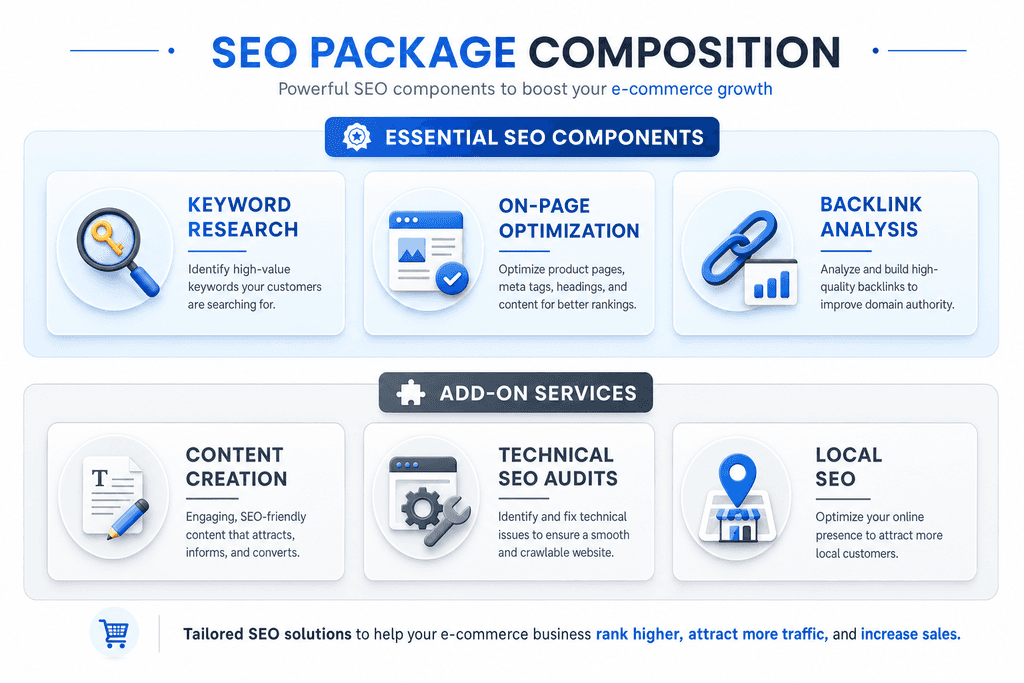
Here’s a quick breakdown of what usually shows up in an SEO package, and how common each piece is depending on the price tier.
| Inclusion | Budget Packages | Mid-Range | Premium |
|---|---|---|---|
| SEO Audit | Basic, automated | Manual review | Deep technical audit |
| Content Creation | Rare or thin | 1-2 pieces monthly | Ongoing strategy |
| Link Building | Rarely included | Basic outreach | Digital PR campaigns |
| Technical Fixes | Minimal | Standard fixes | Full technical support |
| Reporting | Automated only | Monthly summary | Custom, detailed reports |
The labour-intensive parts, like digital PR, tend to get cut first in cheaper packages. Building real backlinks takes time, relationships, and skilled writers, which costs more than running an automated audit tool. This is one reason SEO pricing in Australia varies so widely between providers.
E-commerce businesses also need things a typical local service package won’t cover, such as:
- Product page optimisation across hundreds or thousands of SKUs
- Category page structure and internal linking
- Handling duplicate content from filters and variants
- Technical fixes for site speed on large catalogues
Understanding these differences is the first step before comparing seo packages australia wide, since not all packages are built for online stores.
SEO Package Tiers in Australia Compared
A lot of Aussie SEO agencies quietly price their packages within the same three bands. Once you know these bands, you stop guessing whether a quote is fair or way off. It also helps you figure out what stage your store is actually at, rather than what a sales call tells you. Most e-commerce founders overpay early on because nobody showed them this comparison first.
Here’s roughly how the market breaks down right now, based on typical offerings from Sydney and Melbourne based agencies.
| Tier | Price Range | Best For |
|---|---|---|
| Basic/Starter | $500–$1,500/mo | Very small stores, single product lines |
| Standard/Growth | $1,500–$4,000/mo | Growing stores with 20+ SKUs |
| Premium/Enterprise | $4,000–$10,000+/mo | Established brands, multi-category catalogues |
The Starter tier usually covers basic on-page fixes, a handful of keywords, and maybe one blog post a month. It’s fine if you’re testing the waters, but don’t expect it to move the needle on revenue.
Standard/Growth packages add proper technical audits, more consistent content, and some link building. This is where most product-based businesses actually see traction, because there’s enough monthly work to compound.
Premium tiers bring in digital PR, dedicated strategists, and often custom reporting dashboards. What separates a $1,000 package from a $5,000 one usually isn’t the report length, it’s whether the work is tied to commercial outcomes like conversion rate and average order value, not just rankings. That distinction matters more than most people realise until they’ve wasted six months on the wrong tier.
Red Flags and Green Flags When Comparing Providers
Once you’ve got a rough price benchmark, the next job is figuring out who’s actually good versus who just sounds good on a sales call. This part trips up a lot of first-time buyers because SEO proposals can look impressive on paper while hiding some pretty obvious warning signs. If you’ve ever gotten a quote that promised “page one rankings in 30 days,” you already know what we mean.
Here’s a quick list of things to watch for before you sign anything.
- Red flag: Guaranteed rankings, especially for competitive keywords
- Red flag: Vague monthly reports with no link to sales or conversions
- Red flag: Pricing given before any audit of your site
- Green flag: A diagnostic-first process that starts with an audit
- Green flag: Transparent explanation of where backlinks come from
- Green flag: Case studies with actual numbers, not just “increased traffic”
Traffic alone is a shaky metric for online stores. You can double your visitors and still sell the same number of units if the wrong people are landing on your pages. This is a good breakdown of how to vet an SEO agency beyond the surface-level pitch.
A cheap generalist agency might handle everything from real estate to cafes to online stores. A specialist e-commerce SEO agency, on the other hand, understands product feeds, category page structure, and how seasonality affects your catalogue. Neither is automatically wrong, but the fit matters more than the price tag.
One Example How ScaleCurrent Structures Its SEO Packages
To make this less abstract, it helps to look at one real example of how a diagnostic-first agency actually structures its offering. We’re not saying this is the only right way to do it, but it’s a useful benchmark against the tiers above. At ScaleCurrent, every engagement starts with an SEO audit, not a sales pitch. That audit tells us what’s actually broken before we recommend anything, which sounds obvious but a surprising number of agencies skip it entirely.
From there, the work usually falls into one or more of these buckets, depending on where the business is at.
- Organic Authority SEO for building long-term search visibility
- Content Strategy for filling gaps in product and category pages
- AI SEO for staying visible as search behaviour shifts
What tends to set this apart from a lot of the market is who’s doing the work. ScaleCurrent is built by people who’ve actually run e-commerce operations, not just marketers who’ve read about them. That matters when a recommendation has to work with your inventory system, your fulfilment timelines, or your margin structure, not just look good in a strategy deck.
On the link building side, we lean on ethical digital PR rather than quick paid link schemes that can put your site at risk. Google’s own guidance on link spam policies is worth a read if you want to understand why this matters long term.
A diagnostic-first onboarding, at a basic level, usually includes the following checks.
- Technical crawl and indexing review
- Content gap analysis against competitors
- Backlink profile health check
- Conversion path review, not just traffic sources
If you’re mid-way through comparing quotes right now and none of them have mentioned an audit yet, that’s worth asking about before you commit to anything. You can always reach out to hello@scalecurrent.com.au if you want a second opinion on a proposal you’ve already got.
How to Match a Package to Your Growth Stage
Most stores buy SEO packages the way they buy shoes, going for the biggest size thinking they’ll grow into it. That’s backwards. A brand new store with 20 products doesn’t need the same setup as a business shifting thousands of SKUs across ten categories. Picking a package based on your business stage, not just what looks impressive on a pricing page, saves money and gets results faster. This is where a lot of Australian e-commerce brands trip up before they even start.
Here’s a stat worth sitting with: most SEO packages Australia wide take around 4 to 6 months before you see measurable movement in rankings and traffic. If a provider promises faster, be a bit sceptical. That timeline matters because it tells you something important, you need a package that fits where your business actually is right now, not where you hope it’ll be in a year.
Early-stage stores often fall into a trap. They sign up for premium tiers loaded with content production, technical audits, and digital PR, but they don’t have the product pages, category structure, or basic content foundation to make any of that useful. It’s like hiring a personal trainer before you’ve bought running shoes.
- Small catalogues (under 100 products) usually do fine with a Starter or Standard package
- Growing brands with 500+ SKUs typically need the Standard-to-Premium range for coverage
- Multi-category stores with seasonal changes need ongoing content, not one-off audits
- Businesses expanding into new markets need packages with room for extra keyword research
Budget isn’t the only thing to weigh up either. Your team’s capacity to act on recommendations matters just as much. A package full of technical fixes is useless if nobody in-house can implement them, and the agency isn’t doing it for you. Before signing anything, ask providers a direct question, how do they measure success beyond rankings. Look for answers involving organic revenue, conversion rate, and actual sales impact, not just ranking screenshots.
- Does the package include implementation, or just recommendations
- How often will you get reporting on organic revenue, not just traffic
- What happens if your catalogue grows mid-contract
For more on how AI search is changing what “ranking” even means these days, this roundup on web design, SEO, and AI search is worth a browse. It’s a good reminder that fit matters more than tier names.
Wrap-up Picking the Right SEO Package
So here’s the thing about seo packages australia wide. Most of them look pretty similar from the outside. Same buzzwords, same tiered pricing tables, same promise of “more traffic.” But once you actually dig into what’s included, the gaps show up fast.
A cheap package with no audit is not actually cheap if it points your site in the wrong direction for six months. And a pricey package isn’t automatically better if nobody bothered to check what’s broken before pitching you a plan.
Before you sign anything, run through this short list:
- Compare what’s actually inside each tier, not just the dollar figure at the top
- Ask if they diagnose your site first, or just hand you a template
- Match the package to where your business actually is right now, not where you hope to be in a year
- Check if the backlink and content approach sounds ethical or sounds like a shortcut waiting to backfire
If a provider can’t explain why they picked a particular package for your store, that’s worth pausing on. The good ones start with a diagnosis, not a sales pitch.
That’s the approach we take at ScaleCurrent. Before we talk packages, we look at what’s actually happening on your site, then match the work to your stage and capacity. It’s one way to think about it, alongside whatever else you’re comparing.
Got questions about how this plays out in practice? We answered a few common ones below.
Common Questions About SEO Packages in Australia
Picking through seo packages australia businesses offer can feel like reading a phone bill you don’t understand. Everyone’s got different names for the same thing, and prices jump around for reasons that aren’t always clear. Below are the questions we get asked most when people are comparing their options. Hopefully these clear up some of the fog before you sign anything.
How much does SEO cost in Australia per month
Most small to mid-sized e-commerce businesses pay somewhere between $1,500 and $5,000 a month, though some agencies charge less and some charge a lot more. The price usually depends on how competitive your industry is and how much content or link building work is involved. Anything wildly cheaper than that range is worth a second look.
What’s included in a typical SEO package
Most packages bundle together a few core things, though the mix changes depending on the provider.
- Technical audits to fix site issues
- Keyword research and on-page updates
- Content creation or optimisation
- Some form of link building or digital PR
- Monthly reporting
Some agencies also throw in AI SEO work now, since search engines are changing how they surface answers. It’s worth asking if that’s covered or if it’s an extra cost.
How long before SEO packages show results
Most businesses start seeing movement around the three to six month mark, with stronger gains showing up closer to month nine or twelve. Anyone promising first-page rankings in a few weeks isn’t being straight with you. SEO is slow because search engines need time to trust the changes you’re making.
Is a cheap SEO package worth it for a small online store
Cheap packages often skip the technical audit stage, which means you could be building on a shaky foundation without knowing it. Some also rely on low-quality backlinks that can hurt you later. It’s not that cheap is always bad, but it’s worth checking what’s actually being done each month.
How does ScaleCurrent’s approach differ from standard packages
A lot of standard seo packages australia providers sell are pretty templated, regardless of whether it’s a big name like StudioHawk or a smaller local shop. We start every engagement with a proper diagnosis of what’s actually happening on your site before recommending anything. Our Organic Authority SEO approach focuses on ethical link building and content that ties back to actual sales, not just traffic numbers that look nice in a report.
Want to know how visible your business is in Google and in AI answers? Request an authority audit and we will show you what is holding it back.